Rent Increases After the Renters’ Rights Act: What Still Works (and What Doesn’t)
Explains how rent increases will operate under the new regime, including notice requirements, justification, timing, and the risk of challenge. Walks landlords through a defensible process that reduces tribunal risk and preserves relationships with good tenants.
RENT, TENANCIES & POSSESSION
Arman Khosravi - Solicitor
1/30/20261 min read
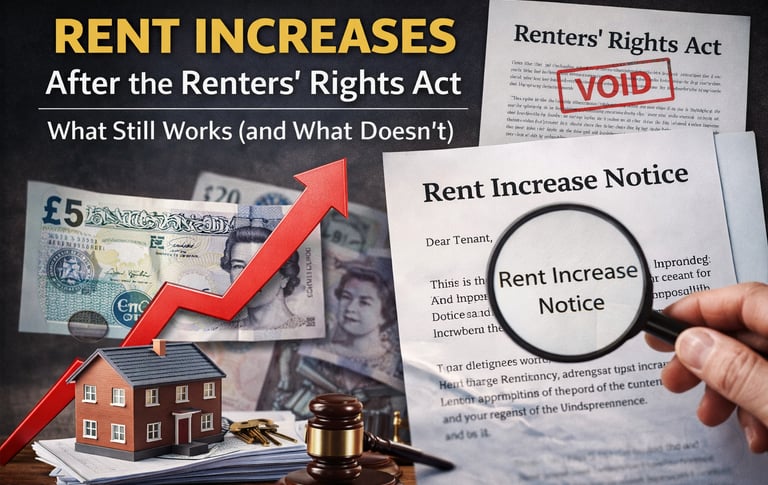
Rent increases are becoming one of the most sensitive areas of landlord-tenant relationships. Legislative reform has shifted the balance further towards scrutiny, transparency and justification, and landlords who approach rent increases casually are increasingly exposed to challenge.
Under the new framework, the ability to increase rent still exists, but the process matters more than ever. Notices must be correct, timing must be defensible, and the increase itself must be justifiable by reference to the market and the condition of the property. Informal approaches that once worked are now far more likely to backfire.
What we see in practice is that many disputes arise not because the rent increase is unreasonable, but because the process is poorly handled. Increases communicated abruptly, without explanation, or at moments of existing tension often lead to formal challenge, complaints, or tribunal involvement.
At Hermens, rent increases are treated as part of a broader risk-management strategy. We advise landlords not just on what they can do, but on what they should do if they want to maintain income without triggering disputes. That includes evidence-based market comparisons, careful timing, and clear written communication that can be relied on if challenged.
For managed properties, we take responsibility for the entire process, ensuring notices are valid, communications are measured, and records are maintained. For landlords managing independently, we often advise before notices are served, so mistakes are avoided rather than corrected later.
In the current environment, a rent increase is not just a financial decision. It is a legal and strategic one. Handled properly, it preserves value and relationships. Handled poorly, it can escalate quickly into something far more costly than the increase itself.
Lettings, Sales & Property Management.
Email & Telephone:
Contact us now:
Address: 87 Lancaster Road, London, W11 1QQ
Registered Office: Watersmead, Addlestone Road, Addlestone, KT152RX
© 2026 Hermens Ltd Co reg: 16063390 | Terms & Conditions | Privacy Policy | Complaints Procedure
Disclaimer: Hermens Property is not a law firm and does not provide legal services or advice. Legal work is carried out by independent regulated law firms.